 How-to
Mobile Car Key Replacement Knoxville: 2026 How-To Guide
Table of Contents
- Mobile Car Key Replacement Knoxville: How On-Site Service Works
- What to Prepare Before You Call for Mobile Car Key Replacement
- Car Key Fob Programming: What Happens On-Site
- Lost Car Key Replacement: Step-by-Step Process
- All Keys Lost Car Replacement: When Every Key Is Gone
- Mobile Locksmith Cost for Car Keys: What Drives the Price
- Mobile Locksmith vs. Dealership: Which Should You Call?
- After the Service: Testing, Troubleshooting, and Spare Keys
- Frequently Asked Questions
Last Updated: October 5, 2026
Mobile Car Key Replacement Knoxville: How On-Site Service Works
Mobile car key replacement Knoxville brings the locksmith to your vehicle instead of the other way around. A technician arrives with key-cutting and programming equipment, reads your vehicle's immobilizer, and cuts and programs a working key in your driveway, office lot, or roadside.
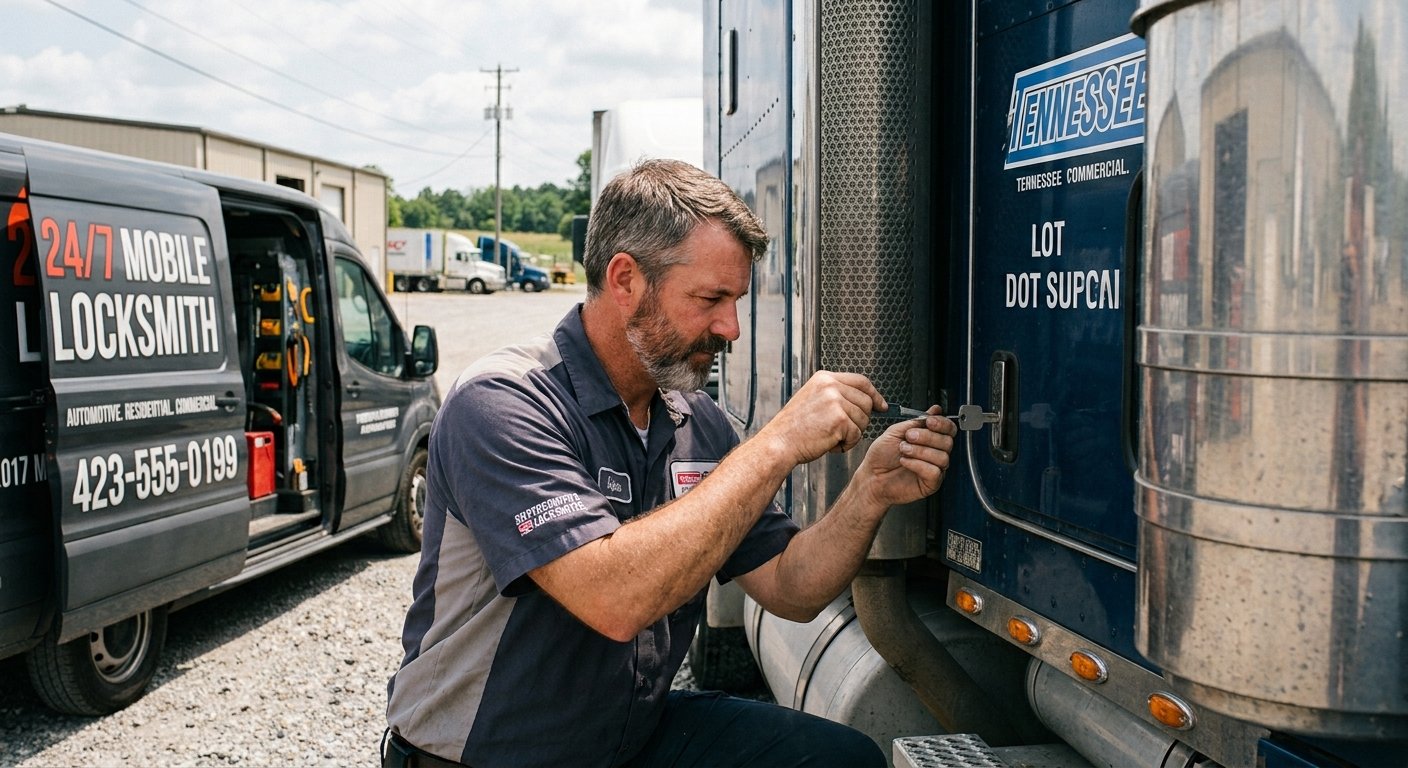
A locksmith kneeling beside a locked semi tracker picking the lock, with a service van parked behind and daylight visible
The process is straightforward. You call, describe the vehicle, and a dispatcher confirms what's needed. Because the equipment travels with the technician, most jobs finish in a single visit.
Why Mobile Service Beats a Tow to the Dealership
Towing is the hidden cost in most key emergencies. A dealership visit usually means a tow, a service queue, and a second trip to collect the vehicle.
- No tow bill or waiting on a flatbed
- No service-department queue behind scheduled repairs
- One visit covers entry, key cutting, and programming
For a driver locked out at 9 PM on a Saturday, that last point decides everything. A dealership parts counter is closed; a mobile locksmith is not.
What to Prepare Before You Call for Mobile Car Key Replacement
Have your vehicle identification number ready before you dial. The VIN tells the technician the exact key blank and transponder type your vehicle needs, which shortens the call and reduces the chance of a second visit.
Gather these items first:
- Vehicle year, make, and model
- VIN, found on the dashboard or insurance card
- Proof of ownership or registration
Documents and Vehicle Details That Speed Up Dispatch
Verification protects you. The Federal Trade Commission's consumer guidance on identity theft explains why matching ID to ownership matters.
If you're not the registered owner, say so upfront. A dealer or fleet manager can usually provide a letter of authorization on company letterhead, which keeps the job moving.
Car Key Fob Programming: What Happens On-Site
Car key fob programming links a new key or remote to your vehicle's immobilizer so the engine will start and the doors will lock.
Two key types dominate modern vehicles:
Key Type | How It Works | Programming Needed |
|---|---|---|
Transponder key | Chip in the key head talks to the immobilizer | Yes, chip must be paired |
Remote key fob | Buttons plus a transponder chip | Yes, remote and chip both paired |
Smart key | Push-button start, proximity unlock | Yes, most complex pairing |
A common mistake is buying a cheap key online and assuming it will program. Blank keys and uncut fobs often can't be paired without the right tooling, and some arrive already locked to another vehicle.
Lost Car Key Replacement: Step-by-Step Process
Lost car key replacement follows a predictable sequence, and knowing what happens at each stage helps you plan your day and spot a provider who is cutting corners. Here is how a mobile call typically runs, with the mechanism behind each step.
Step 1: Call and Describe the Vehicle
Give the dispatcher the year, make, model, and VIN. The VIN is the single most useful piece of information you can provide, because it tells the technician the exact key blank, the transponder or smart-key type, and whether the vehicle needs a security-code lookup before the key can be programmed.
Step 2: Confirm Ownership
Provide your registration and a photo ID matching the registered owner. This step exists because a car key is a physical credential to the vehicle, it starts the engine and opens the doors. Reputable providers verify ownership before cutting anything. If you are not the registered owner, a dealer or fleet manager can provide a letter of authorization on company letterhead.
Step 3: Dispatch
A technician is routed to your location with the correct blanks and programming equipment. This is the advantage of mobile service: the tooling travels with the technician, so the job does not depend on a shop appointment or a tow.
Step 4: Gain Entry
Non-destructive tools open the door without damaging glass or trim. This matters because a broken window costs far more than the key job itself. A technician who reaches for a hammer or a pry bar is not following standard practice.
Step 5: Cut the Key
The blank is cut to your lock's specification. On older vehicles this is a mechanical cut. On newer vehicles the cut may be a laser or sidewinder profile, which requires a different machine. The technician should have the right cutter on the van for your vehicle's key profile.
Step 6: Program the Key
The immobilizer is paired to the new key. The technician connects a programming tool to the vehicle's diagnostic port, erases the old key data if needed, and writes the new key into the system. This is the step that separates a working key from a key-shaped object.
Step 7: Test Everything
Doors, ignition or push-button start, and remote functions are verified before the technician leaves. Test the key yourself while the technician is still on site. Try every door, the trunk, the ignition, and the remote's lock and panic buttons. If something does not respond, it is far easier to fix on the spot than to schedule a return visit.
How Long Each Step Takes
Entry and cutting are usually the fastest parts of the job. Programming is where time varies most: a simple transponder write can take a few minutes, while a smart-key relearn or a security-code lookup on a newer vehicle can take considerably longer. All-keys-lost jobs add time because there is no working key to copy from.
What Can Go Wrong
Most jobs finish in a single visit, but a few situations can extend the process:
- The vehicle's anti-theft module is faulty, so a new key alone will not solve the no-start.
- The key blank is locked to another vehicle and cannot be reprogrammed.
- A security-code lookup is required and the vehicle's documentation is not available.
When the module itself is the problem, on-site key work may need to be paired with module repair. That is a different service from key cutting, and not every mobile provider offers it.
All Keys Lost Car Replacement: When Every Key Is Gone
All keys lost car replacement is the hardest scenario, because there's no working key to copy and the immobilizer may need to be reset.
This is where experience shows. Older vehicles sometimes accept a straightforward new-key write. Newer models may need security access, module communication, or a full immobilizer relearn.
At Dealerkeys, we handle both sides of that equation: on-site Replace keys and mail-in Clone modules for BCM, ECU, and immobilizer modules when the electronics are the real problem.
Mobile Locksmith Cost for Car Keys: What Drives the Price
Mobile locksmith cost for car keys is not a flat rate. It is a range built from four inputs: the key type, whether you still have a working key, the vehicle's year and make, and the logistics of getting a technician to you. Understanding how those inputs stack lets you sanity-check any quote you receive.
The Four Cost Inputs, In Order of Impact
1. Key type. A traditional metal key with no chip is the cheapest job.
2. Spare versus all keys lost. Cutting a duplicate from a working key is faster and cheaper than originating a key from scratch.
3. Vehicle year, make, and model. This is where the range widens most.
**4.
What a Realistic Quote Looks Like
A provider who asks for your VIN before quoting is doing it right.
A quote given without the VIN is a placeholder. It will almost always move once the technician sees the vehicle, and that movement is the single most common source of pricing complaints in this trade.
How to Compare Two Quotes Fairly
When you have two numbers in front of you, make sure they cover the same scope:
- Does the quote include the key blank, or is that billed separately?
- Does it include cutting and programming, or just the hardware?
- Is there a separate dispatch or after-hours fee?
A lower headline number that excludes programming is not actually lower. Ask for the all-in figure before you commit.
Why We Don't Publish a Flat Price
A single published number would be misleading across the range of vehicles on the road. A transponder key on an older sedan and a smart key on a late-model truck are not the same job, and pricing them the same would either overcharge the first driver or lose money on the second.
Mobile Locksmith vs. Dealership: Which Should You Call?
A mobile locksmith wins on speed and convenience for most key emergencies. A dealership makes sense when the work is tied to a warranty repair or a manufacturer recall on the lock or immobilizer system.
Factor | Mobile Locksmith | Dealership |
|---|---|---|
Response time | Same day, often same hour | Usually next business day |
Towing required | No | Often yes |
Weekends and evenings | Commonly available | Rarely |
Fleet and multi-vehicle work | Yes, on site | Limited |
Warranty-linked repairs | Not applicable | Yes |
For a used-car lot with thirty vehicles and a backlog of key issues, mobile service is the practical choice.
After the Service: Testing, Troubleshooting, and Spare Keys
Test the new key before the technician leaves. Try every door, the trunk, the ignition or push-button start, and the remote's lock and panic functions.
A few things to watch in the days after:
- Remote range that fades may point to a weak fob battery
- An intermittent no-start can signal an immobilizer or module fault
- A worn or cracked key should be replaced before it breaks in the lock
Order a spare key while the technician is already there. A backup key costs less than a second service call, and it turns the next lockout into a minor inconvenience.
Frequently Asked Questions
Can a mobile locksmith make a new key on-site for my car?
Yes, a mobile locksmith can cut and program a new key at your location for most vehicle makes and models. The technician brings key blanks, cutting equipment, and programming tools to your car, home, or office. For standard transponder keys and key fobs, the process usually takes under an hour. Some high-security or newer smart keys may require a follow-up visit if a specific blank is not on the van, but most jobs are completed in one trip.
How long does mobile car key replacement take?
Most mobile car key replacement jobs finish in 30 to 60 minutes once the technician arrives. Simple duplicate keys can take 15 to 20 minutes. Programming a new transponder key or key fob often adds 15 to 30 minutes depending on the vehicle. If all keys are lost, the process may take longer because the system needs to be reset and a new key programmed from scratch. Response time for dispatch varies by location and time of day.
What information do I need to get a car key replaced?
Have your vehicle identification number (VIN), proof of ownership (registration or title), and a valid photo ID ready. The VIN is usually visible on the driver's side dashboard or the door jamb. Proof of ownership protects you and the locksmith from key theft. If you have the key code from the original key tag or owner's manual, that speeds up cutting. For key fob programming, know the exact trim level and whether the vehicle uses a smart key or standard transponder.
Is a mobile locksmith more expensive than a dealership?
Not always. A dealership often charges for towing, key cutting, and programming separately, and you may wait days for an appointment. A mobile locksmith bundles the service call, key, and programming into one visit. The total can be lower, similar, or higher depending on your vehicle and key type. For older cars with basic keys, mobile service is frequently cheaper. For luxury or late-model smart keys, pricing depends on the key blank and programming complexity. Always ask for a quote before booking.
A lost key at the wrong hour is one of the few problems that gets worse the longer you wait. Dealerkeys provides mobile dispatch seven days a week, OEM-level key cutting and fob programming, and expert diagnostics for the immobilizer and module faults that stop a new key from working. When a dealership trip isn't practical, get started with Dealerkeys and have a working key in hand the same day. Call for dispatch.