 Ultimate guide
How to Choose a Mobile Locksmith for Your Vehicle
Last Updated: November 4, 2026
Quick Summary
To choose a mobile locksmith, verify the legal business name, physical address, insurance, and technician credentials before dispatch, then confirm the technician's identity and written estimate on arrival. A legitimate mobile locksmith will also verify you own the vehicle before cutting or programming a key.
- Ask for a written estimate broken out by call-out fee, labor, parts, and programming before dispatch.
- The average locksmith service fee is just under $100, per the Locksmith Ledger 2026 survey.
- Read two-star reviews first and check whether the business responds to complaints.
- Confirm the technician has the key blank and diagnostic tool for your exact make, model, and year.
- Pay by credit card when possible so you have a record and a dispute path.
Table of Contents
- Why Choosing the Right Mobile Locksmith Matters
- How to Verify a Locksmith Before You Book
- Questions to Ask a Locksmith Before Booking
- Confirm Vehicle-Specific Capability and Key Technology
- Automotive Locksmith Cost: What Goes Into a Quote
- Mobile Locksmith vs Dealership: Which Fits Your Job
- Response Time, Availability, and Safety on Emergency Calls
- Call Dealerkeys for Mobile Dispatch
- Frequently Asked Questions
Why Choosing the Right Mobile Locksmith Matters
The U.S. locksmith industry is a $3.0 billion market spread across 29,620 businesses, according to IBISWorld's locksmith industry analysis, which means you have plenty of options and very little default quality control. Knowing how to choose a mobile locksmith comes down to verification, not luck. At Dealerkeys, we have over 26 years of experience in the trade. The Federal Trade Commission's consumer caution on locksmiths warns that some providers advertising as local may not be local and may lack professional credentials at all.
How to Verify a Locksmith Before You Book
Verification is a five-minute process that most people skip in a panic. Do it before you hand over a vehicle, not after. The goal is to confirm three things: that the business is real, that the technician is authorized to work on your vehicle, and that you can identify who is coming before they arrive.
Check Licensing, Insurance, and Business Address
Ask for the legal business name, a physical business address, and proof of insurance before dispatch. A provider that cannot produce a street address or a certificate of insurance is a risk you don't need. Licensing requirements vary, so ask directly what credentials the technician holds and who regulates them locally. A legitimate operation will give you a business name that matches the name on the estimate, the insurance certificate, and the technician's invoice.
Read Online Reviews and Ask for Recommendations
Reviews matter, but pattern matters more than star average. Read the two-star reviews first, look for complaints about surprise charges or damage, and check whether the business responds. A recommendation from a dealership service advisor or a fleet manager carries more weight than any listing. Consider checking the business name with a local consumer affairs agency; a pattern of unresolved complaints is more telling than any single review.
Confirm Identity and Business Details Before Dispatch
Before you agree to a visit, get the technician's name, the business's phone number, and the vehicle description the dispatcher will send. Ask the dispatcher to text or email a confirmation with the business name, the quoted price range, and the technician's name. When the technician arrives, compare the name and business on the invoice to the confirmation you received. A technician who cannot produce a business card, invoice, or ID that matches the dispatch confirmation is a reason to pause, especially after hours when you are stranded.
Verify Ownership and Authorization on Arrival
A legitimate technician will verify that you own or are authorized to operate the vehicle, typically by asking for registration, ID, or proof of insurance, and will confirm the vehicle identification number before cutting or programming a key. Expect that check; it is a sign of a professional operation, not an inconvenience.
Watch out: a dispatcher who refuses to give a business address or a technician's name before arrival, or who pressures you to pay a deposit by phone, is showing a pattern worth avoiding.
Questions to Ask a Locksmith Before Booking
Ask these questions on the call, before you agree to anything, and note the answers:
- What is your business address and license or registration number?
- Do you carry liability insurance?
- Can you confirm you have the key blanks and programming tools for my exact vehicle make, model, and year?
- Will you give me a written estimate before work starts, including call-out, labor, and parts?
- What happens if the key cannot be programmed on-site?
- Is there a warranty or guarantee on the key and the programming?
A technician who answers these without hesitation is a technician worth hiring. One who dodges the address question or refuses a written estimate is telling you something useful.
Confirm Vehicle-Specific Capability and Key Technology
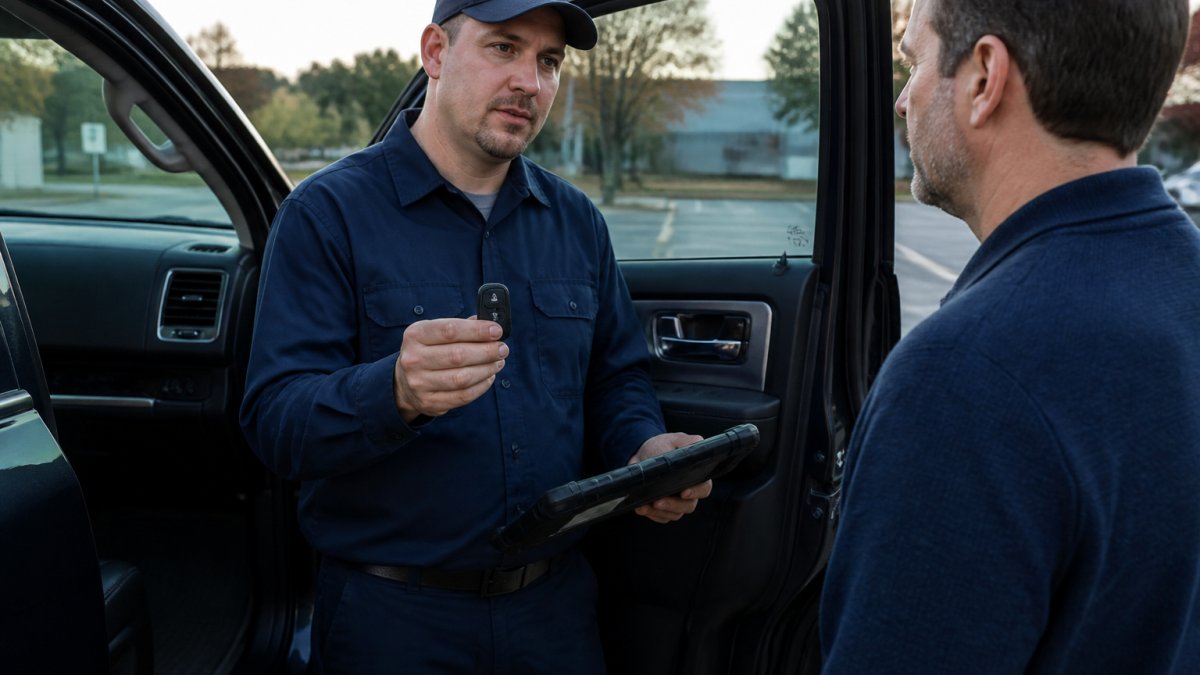
Capability is vehicle-specific, and this is where generic locksmiths fall short. Modern vehicles use transponder keys, smart key fobs, and immobilizer systems that require model-specific programming and, often, OEM-level diagnostic equipment. A provider that cuts keys for a 2005 sedan may have no path into a 2019 Honda with a dead fob and a lost key.
Confirm three things: the technician has the key blank for your vehicle make and model, the diagnostic tool covers your model year, and the shop has handled your platform before. Aftermarket equipment libraries sometimes lag behind a brand-new model year, which is a legitimate reason a job may need to go elsewhere. Ask the question directly: "Have you programmed this year and model before?"
Automotive Locksmith Cost: What Goes Into a Quote
Automotive locksmith cost breaks into four parts: call-out or dispatch fee, labor, the key or fob part itself, and programming time. The Locksmith Ledger 2026 National Average Price Survey puts the average service fee just under $100, with prices generally higher in major metropolitan areas. That figure is a service baseline, not a full key replacement quote, and it does not include the cost of a fob or programming on a newer vehicle.
Ask for the estimate in writing, broken out by line item, before dispatch. For a deeper breakdown of what key programming and service pricing includes, read our pricing guide.
| Quote Line Item | What It Covers | Ask Before Booking |
|---|---|---|
| Call-out fee | Travel to your location | Is it flat or distance-based? |
| Labor | Time on the vehicle | Hourly or flat rate? |
| Parts | Key blank or fob | OEM or aftermarket? |
| Programming | Diagnostic and pairing time | Included or separate? |
How to Verify a Quote Before You Agree
A written estimate should state the total range, not just a starting price, and it should separate parts from labor. Ask the dispatcher to confirm four things in writing: the call-out fee, the labor rate and whether it is hourly or flat, whether the key or fob is OEM or aftermarket, and whether programming is included. If the estimate is a single number with no breakdown, ask for the breakdown before you agree.
What Triggers a Price Change on Arrival
Price changes on arrival usually trace to one of four causes: the vehicle turns out to need a more expensive key type than the dispatcher assumed, the job requires extra programming time, the visit falls outside standard hours, or the technician adds a difficulty fee. Before work starts, ask the technician to confirm the price in writing and to explain any difference from the estimate. If the new price is higher, ask which line item changed and why. You are allowed to decline the work before it starts; a legitimate provider will explain the change rather than pressure you to proceed.
How to Handle a Final Bill That Differs From the Estimate
If the final bill is higher than the written estimate, compare it line by line to the estimate before you pay. Ask for an itemized invoice that shows parts, labor, programming, and any after-hours charge. If a charge was not disclosed before work began, say so and ask for it to be removed or explained.
Watch out: a quote that changes on arrival and is justified only as a "difficulty fee," with no line-item explanation, is the most common complaint pattern in this trade.
Mobile Locksmith vs Dealership: Which Fits Your Job
A mobile locksmith wins on time and convenience for most lockouts and key replacements; a dealership wins on specific edge cases. A dealership may be the better call when your vehicle has an active immobilizer warranty or recall, or when the job involves a manufacturer-specific security procedure.
For everything else, a mobile provider cuts the tow, the appointment wait, and the dealership labor rate. If you want to understand the dealer side of that math first, read why dealership key replacements cost so much before you decide.
Response Time, Availability, and Safety on Emergency Calls
Response time is the headline number on an emergency call, and availability separates real operations from call centers. If your lockout happens on a weekend, see what to expect from weekend mobile locksmith availability in Knoxville. If you want to know how long a mobile key replacement takes before committing to a call, our guide covers typical timelines.
Safety and identity checks protect both sides. A legitimate technician will verify that you own or are authorized to operate the vehicle, typically by asking for registration, ID, or proof of insurance, and will confirm the vehicle identification number before cutting or programming a key.
Call Dealerkeys for Mobile Dispatch
A smooth key replacement depends largely on verification done in advance. If your fob is dead and the vehicle won't start, our No Start Guide walks you through the likely causes before you call, and if you'd rather not pay dealer prices for a replacement, we can replace keys for most makes and models. For immediate guidance on getting help dispatched, read emergency car lockout services: what to do now.
Frequently Asked Questions
Is a mobile locksmith worth it for car key replacement?
For most drivers, yes. A mobile locksmith comes to your location, cuts and programs the key on site, and often costs less than a dealership visit. Pricing varies by vehicle, service area, and job type, so contact Dealerkeys for a quote. The main exception is an active immobilizer warranty or recall, where the dealer may be the better call.
How do I know if a locksmith is reputable?
Start with a verifiable business address and a real local phone number, then read recent online reviews and ratings for patterns rather than single complaints. Some providers advertising as local may not actually be local or may lack professional credentials, so confirm licensing and insurance directly. Ask how long the company has operated and whether technicians use OEM-level tools for key programming and immobilizer work.
What should I ask a mobile locksmith before booking?
Ask for the vehicle make, model, and year they need to confirm capability, whether the quote includes the call-out fee, labor, and parts, and whether it is a written estimate. Confirm they can program a transponder key or key fob on site for your specific model, and check availability and expected response time. Get the total in writing before dispatch.
Can a mobile locksmith program a car key or key fob?
Many can, provided they carry the right diagnostic equipment and have aftermarket equipment-library coverage for your model year. Ask the provider whether a specific make, model, and year is programmable on site. The main case that pushes toward a dealer is an active immobilizer warranty or recall. Ask the dispatcher to confirm your exact vehicle make, model, and year before booking.
How can I compare a mobile locksmith with a dealership?
Compare total cost, time, and convenience. A mobile locksmith provides on-site service, so there is no tow and no drop-off, and pricing should be confirmed through a written quote before parts. A dealer may be required for warranty or recall immobilizer work. For routine key replacement and fob programming, ask both for a written estimate and weigh the time savings against the price difference.
What information should I have ready when requesting a locksmith quote?
Have the vehicle identification number, make, model, year, and whether you have any working key remaining. Note your location and whether the vehicle is in a garage, lot, or street, and describe the problem clearly: lockout, lost key, dead fob, or a security light. This lets the dispatcher confirm vehicle coverage, quote accurately, and send a technician with the right specialized tools and diagnostic equipment.
The next time a key goes missing, you will have about thirty seconds of clear thinking before panic takes over. Use them to ask for an address, a written estimate, and proof of vehicle-specific capability. Get started with Dealerkeys and put a verified mobile technician on the way instead of a gamble.