 How-to
Fix Motorcycle Security Light No Start: Step-by-Step
Table of Contents
- Understanding Your Motorcycle Security Light and No-Start Condition
- Check Battery Condition and Voltage for No-Start Issues
- Diagnose Key Fob and Transponder Recognition Issues
- Motorcycle Immobilizer Troubleshooting and Reset
- Check Starter, Relay, and Ignition Circuit
- Motorcycle Transponder Key Programming and Verification
- When to Stop Troubleshooting and Call a Professional
- Prevent Future Security Light and No-Start Problems
- Frequently Asked Questions
Last Updated: October 11, 2026
Understanding Your Motorcycle Security Light and No-Start Condition
A motorcycle security light no start condition, where the security light stays on while the engine won't crank, means your anti-theft system has detected a problem. This guide from Dealerkeys explains how to diagnose and fix the most common causes of this frustrating problem.
Your motorcycle's security system prevents theft by locking out the starter motor when it detects an issue. The security light flashes or stays solid to signal the problem.
What the security light means
The security light indicates your immobilizer has activated, a transponder-based anti-theft system that recognizes your key and allows the engine to start. When the light stays on, the system doesn't recognize your key or has detected an electrical fault.
Normal behavior: The light flashes once or twice, then goes out as the system recognizes your key. Faulty behavior: The light stays on solid, flashes repeatedly, or blinks unusually, and the starter doesn't engage.
How the anti-theft system prevents starting
Your motorcycle's anti-theft system reads your key's transponder chip and compares it to stored codes. If they match, the immobilizer unlocks the starter circuit. If they don't match or the system can't read the key, it cuts power to the starter relay, preventing the motor from engaging.
Check Battery Condition and Voltage for No-Start Issues
A weak or dead battery is the most common cause of motorcycle security light no-start problems. The security module needs stable voltage to read your key and communicate with the starter relay.
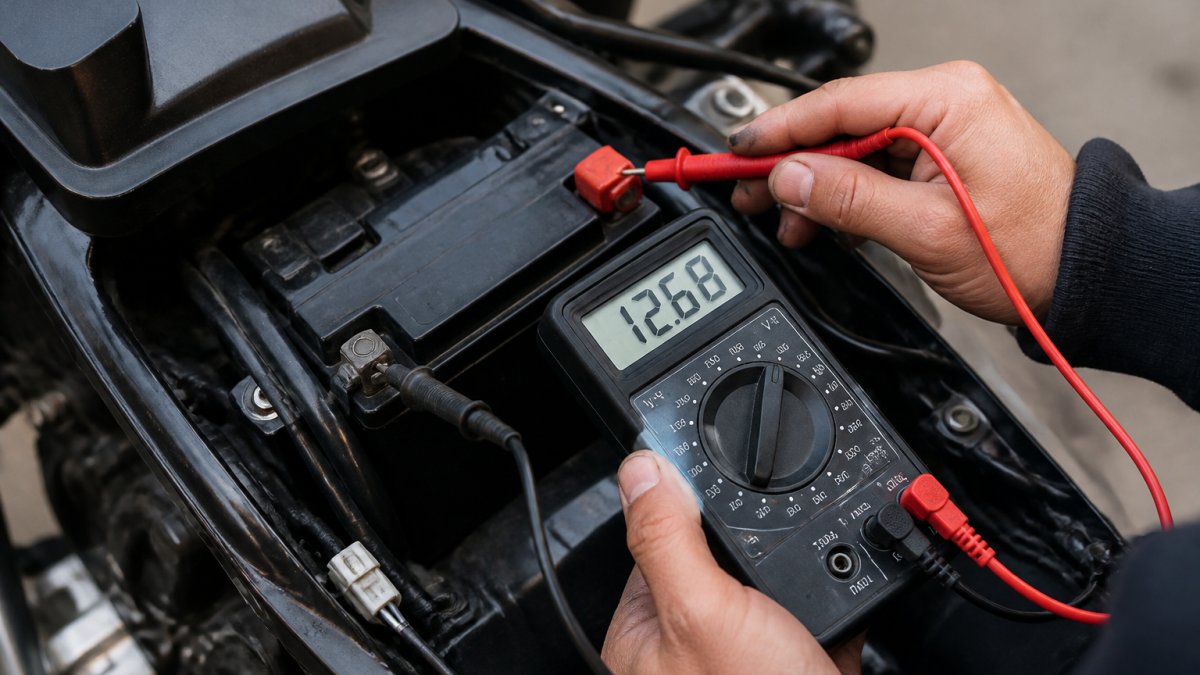
Measuring voltage at the battery terminals
Turn off the ignition and set a multimeter to DC volts. A healthy motorcycle battery reads 12.6 volts or higher when the engine is off. Below 12 volts, your security system won't function properly. If your reading is low, charge the battery fully with a smart charger designed for motorcycle batteries before testing anything else.
Inspecting terminal corrosion and connections
Turn off the ignition and disconnect the negative terminal first. Look for white, blue, or green crusty buildup on the terminals. Clean corroded terminals with a wire brush until shiny, then reconnect the negative terminal last. Wiggle each terminal clamp by hand, it should not move. If it does, tighten the nut or bolt holding it in place.
Diagnose Key Fob and Transponder Recognition Issues
Your key fob communicates with the security module through a transponder chip. If the module can't read that chip, the immobilizer locks out the starter. This section covers how to test your key and fob.
Testing fob proximity and battery
Turn the ignition to "on" without starting and watch the security light. If it flashes once and goes out, the module recognized your key. If it stays on or flashes repeatedly, replace the battery in your key fob first, most use a CR2032 coin-cell battery. If the light still won't go out, move closer to the ignition switch; if it goes out when you're inches away but stays on at arm's length, the transponder antenna may be failing.
Trying your spare key
If the spare key works and the primary key doesn't, your primary key's transponder chip is dead and needs replacement. If both keys fail, the problem is in the security module or ignition switch. Keep your spare key in a safe place; if lost, a professional can help you replace keys using your bike's VIN and security codes.
Motorcycle Immobilizer Troubleshooting and Reset
The immobilizer module is the brain of your security system. It reads your key, checks the data bus for faults, and decides whether to unlock the starter. Sometimes a simple reset clears temporary errors.
Recognizing normal vs. faulty security-light patterns
Normal pattern: Security light flashes once or twice when you turn the key to "on," then goes out. Faulty patterns include: light stays on solid, flashes rapidly (more than 3 times per second), comes on while riding, or flashes in unusual rhythms. A solid light or rapid flashing usually means the module detected a fault code in the data bus, a loose connection, failed sensor, or wiring break.
Basic immobilizer reset procedures
Some motorcycles allow a simple reset: turn ignition off, then on without starting, wait for the light to flash and go out, turn off again, wait 10 seconds, then turn on and try to start. If the light goes out and the bike starts, the reset worked. For more detailed guidance on no-start issues, Dealerkeys offers a No Start Guide that covers common reset sequences and troubleshooting steps.
Check Starter, Relay, and Ignition Circuit
If the battery is good, the key is recognized, and the security light goes out, but the bike still won't start, the problem is in the starter circuit. This section walks you through the mechanical and electrical components that make starting happen.
Listen for clicking or relay engagement
Turn the ignition key to the start position. Listen carefully.
A single loud click means the starter relay is engaging but the starter motor isn't turning. This usually points to a bad starter motor or a broken connection to it.
Rapid clicking (click-click-click) means the relay is trying to engage but not getting enough power. This is often a battery voltage problem, even if your earlier test seemed OK.
No sound at all means the relay isn't engaging.
Inspect fuses and wiring connections
Open your fuse box. Most motorcycles have a dedicated fuse for the starter circuit and another for the security system.
Look at each fuse. A blown fuse has a broken wire inside or a blackened appearance. Replace it with a new fuse of the same amperage.
Trace the wiring from the fuse box to the starter relay and from the relay to the starter motor. Look for cuts, pinches, or corrosion on the connectors.
Motorcycle Transponder Key Programming and Verification
If your key is recognized by the security module but the bike still won't start, or if you've replaced your key and need to program it, this section explains when DIY programming works and when you need professional help.
When DIY programming may work
Some motorcycles allow you to program a new key without special tools. The process usually involves a sequence of ignition on-off cycles while holding the key in a specific position. Your owner's manual will have the exact steps for your model.
DIY programming works only if:
- You have at least one working key to program from
- Your security module hasn't been locked out by too many failed attempts
- Your bike's manual includes programming instructions
- You have the correct security code or PIN for your model
If any of these conditions isn't met, DIY programming will fail. Too many failed attempts can lock your module entirely, making it impossible to start until a professional resets it.
Signs you need professional module diagnostics
Call a professional if:
- You've tried programming and the security light still won't go out
- The light flashes in a pattern you don't recognize
- The light comes on while you're riding
- You have two working keys but the bike won't start
- You've replaced the battery and cleaned terminals but the problem persists
A professional locksmith or dealer can connect a diagnostic scan tool to your bike's data bus. This tool reads the exact fault codes stored in your security module. It shows whether the problem is a failed transponder, a bad ignition switch, a wiring break, or a module failure.
When to Stop Troubleshooting and Call a Professional
At some point, further DIY work wastes time and risks making things worse. Knowing when to stop is just as important as knowing how to diagnose.
Intermittent faults and data-bus errors
If the security light comes on and off randomly, or if it appears while you're riding, the problem is likely an intermittent electrical fault or a data-bus communication error.
An intermittent fault could be a corroded connection that works sometimes, a failing sensor that sends bad data, or a wiring break that makes and breaks contact as the bike vibrates.
Data-bus errors mean the security module can't communicate with other modules on your bike's electrical network.
What to expect from mobile locksmith diagnostics
A professional locksmith like Dealerkeys brings diagnostic tools to your bike. They connect to your security module and read all stored fault codes.
From there, they can tell you exactly what's wrong. If it's a module failure, they can often clone modules or repair it.
Mobile service means you don't have to tow your bike to a dealership. A technician comes to you with OEM-level diagnostic tools and 26+ years of experience troubleshooting these exact systems.
Prevent Future Security Light and No-Start Problems
Once you've resolved your motorcycle security light no start problem, a few simple maintenance steps keep it from happening again.
Routine battery and terminal maintenance
Check your battery voltage every month. A healthy battery holds 12.6 volts or more when the bike is off.
Clean battery terminals twice a year or whenever you see corrosion. A quick scrub with a wire brush takes five minutes and prevents most electrical gremlins.
Use a quality motorcycle battery tender if you park your bike for more than a few weeks. A tender keeps the battery at full charge without overcharging it.
Key fob and spare-key care
Replace your key fob battery every two years, even if it still works. A weak battery can cause intermittent recognition problems that are hard to diagnose.
Keep your spare key in a dry place. Moisture corrodes the transponder chip. Store it in a plastic bag or small sealed container.
Test your spare key every six months. Insert it into the ignition and watch the security light. If it goes out, the spare is good.
*At Dealerkeys, we've spent 26 years diagnosing and fixing motorcycle security light and no-start problems. If your DIY troubleshooting reaches a dead end, we offer mobile on-site diagnostics and key programming and module repair services.
Frequently Asked Questions
Why is my motorcycle security light on and the engine won't start?
A security light with no-start usually means your motorcycle's immobilizer system doesn't recognize your key or key fob. This can happen due to a dead or low battery, a weak key fob battery, corroded battery terminals preventing proper electrical flow, or a faulty immobilizer module. Start by checking your battery voltage (should be at least 12.6 volts) and testing your key fob with fresh batteries. If both test okay, the security module itself may need professional diagnostics.
Can a weak motorcycle battery cause the security light to stay on?
Yes. A weak or dying battery cannot supply enough voltage to properly power the security system module, which causes it to stay illuminated. Additionally, low battery voltage can prevent the starter from engaging, even if the ignition turns on. Check your battery terminals for corrosion and measure the voltage with a multimeter. A healthy battery should read 12.6 volts or higher when the engine is off. If your battery reads below 12 volts, recharge it before troubleshooting further.
How do I know if my motorcycle key fob is the problem?
Try your spare key first. If the spare key starts the bike without triggering the security light, your original fob battery is likely dead or the fob itself is faulty. Replace the fob battery with a fresh one and test again. If neither key works, or if your spare key also triggers the security light, the problem is likely with the immobilizer module or battery, not the fob. A professional can reprogram or diagnose your transponder key and security system.
When should I call a motorcycle locksmith for a security light no-start?
Call a professional if you've checked your battery voltage, tested both your spare and primary keys, verified fuse integrity, and the security light persists. You should also reach out immediately if you hear clicking sounds with no cranking, suspect wiring damage, or your motorcycle starts then immediately shuts off. A locksmith with OEM-level tools can read diagnostic codes from your security module and determine whether you need key reprogramming, module repair, or component replacement.