 How-to
Automotive Module Repair by Mail: A Complete Guide
Table of Contents
- Symptoms of a Faulty Body Control Module or ECU
- How to Diagnose a Faulty BCM Before Shipping
- BCM Programming and Cloning During Repair
- ECU Repair by Mail: What to Expect
- Mail-in Module Repair Turnaround Time and Process
- How to Safely Remove and Ship Your Module
- Repair Versus Replacement: Making the Right Choice
- As a general rule:
- Frequently Asked Questions
Last Updated: October 10, 2026
Symptoms of a Faulty Body Control Module or ECU
A failing body control module or engine control unit shows itself through distinct warning signs: the vehicle won't start, warning lights appear on the dashboard, power is lost to windows or locks, doors lock and unlock randomly, the fuel pump won't engage, or the instrument cluster goes blank. The immobilizer may malfunction, preventing engine start even with a valid key. Multiple fault codes may appear on scan, or the vehicle may run rough and suddenly cut out, often with no obvious cause like accident or water damage.
If you're seeing these signs, the module itself is likely the culprit. The question then becomes whether to replace it or pursue automotive module repair mail service.
How to Diagnose a Faulty BCM Before Shipping
Confirm the diagnosis before removing anything or contacting a repair service. Shipping the wrong component wastes time and money.
Start with a diagnostic scan from an independent shop or auto parts retailer (often free or low-cost). Write down all fault codes, you'll need this information for the mail-in repair provider.
Check for obvious culprits: test battery voltage (healthy batteries read ~12.6V at rest) and clean corroded terminals, which can mimic module failure.
Look for water damage or physical damage: cracks, burned components, or visible corrosion on the circuit board indicate module failure.
BCM Programming and Cloning During Repair
Technicians often reprogram or clone modules rather than replace them. Programming loads factory software and matches it to your vehicle's VIN-based settings (immobilizer codes, security parameters, calibrations). Cloning transfers data from your original module to a replacement, preserving settings in one step and reducing compatibility risk. Both require OEM-level tools and expertise.
Dealerkeys uses professional-grade cloning and programming equipment.
ECU Repair by Mail: What to Expect
When you ship your ECU or BCM through automotive module repair mail, the process follows a predictable path. Understanding each stage helps you know what's happening to your module and why it matters.
Initial Intake and Inspection
The facility logs your module, photographs it, documents visible damage, and verifies the part number. Within 24 hours, they contact you with a preliminary assessment and repair quote.
Bench Testing: The Diagnostic Phase
Bench testing connects your module to specialized diagnostic equipment that simulates your vehicle's electrical environment. The technician applies controlled voltage, reads fault codes, tests circuits, scans memory, and documents findings. This typically takes 24 hours and reveals exactly what failed, a burned capacitor, failed transistor, corroded solder joint, failed memory chip, or software corruption. Reputable services email you the test report.
Repair: Component-Level or Software Fix
Repair methods include component-level repair (desoldering and replacing failed parts), reflashing corrupted memory, cloning from a donor module, or connector/pin repair. Quality services photograph the module before and after repair.
Validation Testing
Once repaired, the module undergoes a second bench test to confirm the fix. If it passes all tests and fault codes clear, the repair is validated. If issues remain, the service contacts you to discuss next steps.
VIN-Specific Programming and Final Preparation
Before shipment, the technician reprograms or clones your vehicle's VIN-specific data into the module to ensure proper communication with your car's systems. The module is placed in an anti-static bag, padded, and prepared for return shipment with tracking and insurance.
Total Timeline
The clock starts when the facility receives your module, not when you ship it. Shipping both ways is usually included in the service price, though you should confirm this before sending anything. Most mail-in providers use insured shipping and provide you with a tracking number. The return trip typically takes 2 to 3 business days depending on your location.
Mail-in Module Repair Turnaround Time and Process
The clock starts when the facility receives your module. Shipping both ways is usually included; confirm before sending. Ask about delay policies, reputable services contact you if extra time is needed.
How to Safely Remove and Ship Your Module
Incorrect removal or improper shipping can damage the module. Follow these steps to protect it.
Gathering Your Vehicle Information
Document your VIN, vehicle make/model/year, engine type, and exact module type. Take photos showing the module's location and connectors. Note the part number printed on the module label, this helps the technician verify compatibility.
Removing the Module Without Damage
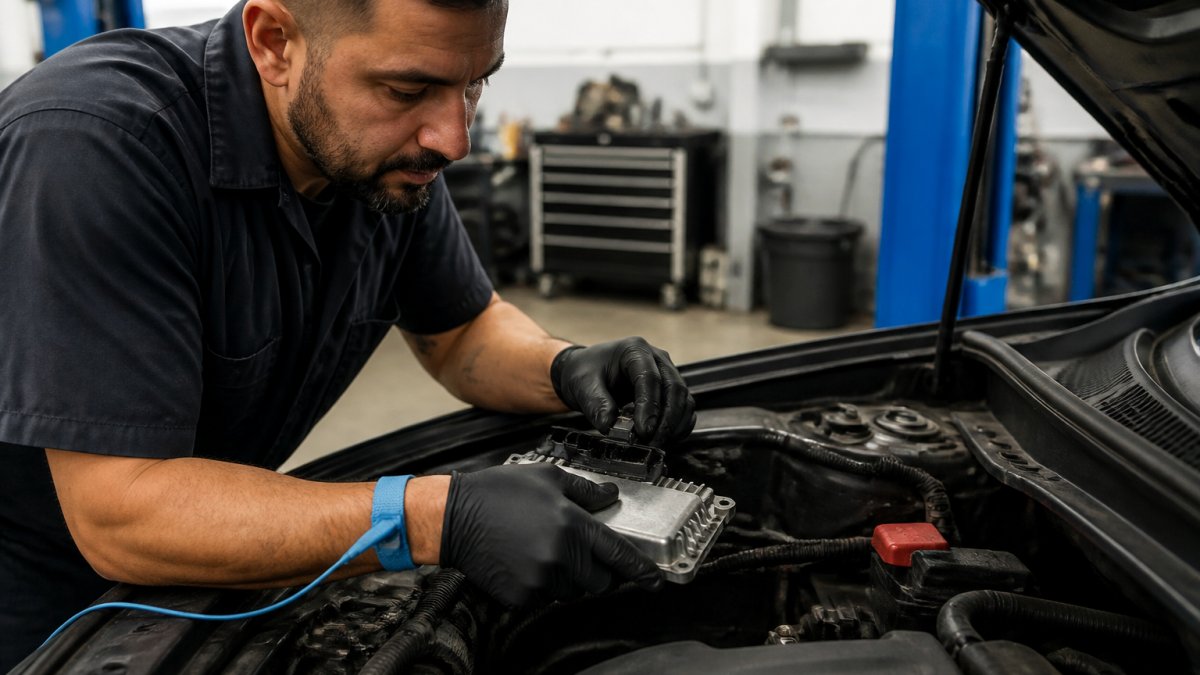
Disconnect the battery and wait 5 minutes. Locate the module using your service manual. Carefully disconnect all connectors by pressing release tabs gently and pulling straight out. Remove mounting bolts with the correct socket size and place them in a labeled bag. Lift the module straight out without twisting. Place it on a clean, dry surface and avoid touching the circuit board or connectors with bare hands.
Packing and Labeling for Safe Transit
Use an anti-static bag. Place your module inside and seal it. This protects sensitive electronics from static discharge during shipping. If you don't have an anti-static bag, wrap the module in several layers of bubble wrap and place it in a padded box.
Wrap the module in additional padding. Use bubble wrap, foam sheets, or packing peanuts. The module should not move inside the box. Place the mounting bolts and connectors in a separate sealed bag inside the main box.
Include a detailed label inside the box listing your name, phone number, vehicle VIN, vehicle make and model, and a description of the problem. Write "FRAGILE, ELECTRONICS" on the outside of the box in multiple places.
Ship via insured carrier. Use a service that provides tracking and insurance. Keep your receipt and tracking number. Most mail-in repair services will provide you with a shipping address and specific instructions, follow these exactly.
Repair Versus Replacement: Making the Right Choice
Not every faulty module needs replacement. Understanding the difference between repair and replacement, and the factors that favor each option, helps you make the right decision for your situation and budget.
When Repair Makes Sense
Repair is the better choice when:
- The damage is localized: A single burned capacitor, a failed transistor, or a corroded solder joint can often be fixed without replacing the entire module.
- The module is original equipment: Your vehicle's original module contains factory calibrations and security settings specific to your car. Repairing it preserves these settings and avoids potential compatibility issues.
- The cost is significantly lower:
- The module is not widely available: Some older vehicles or specialty modules are difficult to source as replacements. Repair keeps your original module in service.
- Water damage is limited: If your vehicle was exposed to moisture but the module was caught early and dried properly, component-level repair can restore function.
Repaired modules also carry less risk of compatibility issues. A repaired original module will always work with your vehicle's other systems because it retains the original hardware architecture and calibration.
When Replacement Is the Better Option
Replacement is the right choice when:
- Physical damage is severe: Cracked circuit boards, multiple burned components, or extensive corrosion often cost more to repair than replacement.
- Water damage is extensive: If the module was submerged for an extended period or exposed to saltwater, internal corrosion may be too widespread to repair cost-effectively.
- The module has multiple component failures: When bench testing reveals more than two or three failed components, the repair cost approaches or exceeds replacement cost.
- The module is obsolete or hard to source: If a repair facility cannot source a specific replacement component, they may recommend replacement instead.
- Warranty concerns exist:
Replacement Options and Costs
When replacement is recommended, you have three options:
New OEM Module: A factory-new module from the vehicle manufacturer. Advantages: guaranteed compatibility, no risk of hidden defects. Disadvantage: highest cost.
Refurbished OEM Module: A used module that has been professionally tested, repaired, and validated. Advantages: significantly cheaper than new, tested and validated. Disadvantage: less warranty coverage than new.
Aftermarket or Clone Module: A third-party module or a cloned copy of your original. Advantages: lowest cost. Disadvantages: potential compatibility issues, higher failure risk if not properly programmed.
Many mail-in repair services can source and program replacement modules if repair is not feasible. Ask about the warranty terms and testing procedures for any replacement they recommend.
Programming and Compatibility Considerations
Any replacement module, whether new, refurbished, or aftermarket, must be programmed to match your vehicle's VIN and configuration. This is not optional. Without VIN-specific programming:
- The immobilizer may not recognize your key
- The module may not communicate with other vehicle systems
- Warning lights may illuminate
- The vehicle may not start or run properly
Some replacement modules come pre-programmed for your vehicle's year and make, but not your specific VIN. These still require final programming before installation. Ask the service provider whether programming is included in the replacement cost.
Making the Decision: Questions to Ask
Before committing to repair or replacement, ask the service provider:
- What does the bench test report show? Request a detailed report listing all faults found and the recommended fix.
- Is repair possible, and what is the cost? If yes, get a written quote.
- If replacement is recommended, why? Ask them to explain which components are too damaged to repair and why repair cost exceeds replacement cost.
- What is the warranty on repair or replacement?
- What is included in the price? Confirm whether programming, return shipping, and testing are included.
- Do you have references or certifications? Ask whether they are ASE-certified, have customer reviews, or can provide references.
Cost-Benefit Framework
As a general rule:
However, this is not absolute. If your vehicle is older, hard to find parts for, or you plan to keep it long-term, repair of the original module may be worth the extra cost to avoid compatibility risks.
Frequently Asked Questions
How do I know if my car's BCM or ECU is faulty?
Common signs include dashboard warning lights (especially check engine or service lights), key fob programming failures, immobilizer system malfunctions, power window or lock failures, and no-start conditions despite a working battery. Diagnostic trouble codes retrieved with a scan tool confirm the issue. If multiple electrical systems fail simultaneously, the body control module or ECU is often the culprit. A qualified technician can verify the diagnosis before you commit to repair.
How long does mail-in automotive module repair take?
Mail-in module repair turnaround time depends on the complexity of the fault and the service provider's workload. Total time includes shipping both ways. Always confirm expected turnaround with your service provider before shipping, especially if your vehicle is time-sensitive.
Can a BCM be repaired, or do I need to replace it?
Many BCM failures can be repaired through bench testing, component replacement, and re-programming without replacing the entire module. Repair is often more cost-effective than replacement and preserves your original module's compatibility. However, if the module has suffered physical damage, corrosion, or multiple failed components, replacement may be the only option. A diagnostic assessment before shipping will clarify whether repair or replacement is appropriate for your situation.
What should I include when mailing a BCM or ECU for repair?
Include your vehicle's VIN, year, make, model, and engine type to ensure accurate programming upon return. Document the symptoms you observed and any diagnostic trouble codes. Provide contact information and shipping address. Do not include the key fob, battery, or other unrelated components. Pack the module securely in anti-static bubble wrap or an ESD bag to prevent damage during transit. Label the package clearly with your name and phone number.